Clinician credentials
Dr Adarsh M. Patil, MS, FMAS · Karnataka Medical Council registration 53728.
View doctor profile
2-5% Recurrence Rate • 2-3 Week Recovery • Lowest Recurrence Rate
Advanced surgical technique by Dr Adarsh M Patil using Limberg and Karydakis flap procedures. Ideal for recurrent pilonidal sinus with superior healing and cosmetic outcomes.
2-5% Recurrence
Lowest among all treatments
2-3 Week Recovery
Return to normal activities
individual treatment planning
Excellent long-term outcomes
Years Experience
Patients Treated
Success Rate
KMC Registration
Quick Summary
Flap surgery for pilonidal sinus uses advanced techniques like Limberg and Karydakis flaps to remove the sinus tract and close the wound with a skin flap. This procedure has the lowest recurrence rate (2-5%), 2-3 week recovery, and excellent cosmetic outcomes. Ideal for recurrent cases or extensive disease.
| Procedure Type | Flap Reconstruction (Limberg/Karydakis) |
| Recovery Time | 2-3 weeks (return to normal activities) |
| Success Rate | 99% (excellent long-term outcomes) |
| Recurrence Rate | 2-5% (lowest among all treatments) |
| Hospital Stay | 1 day (day-care procedure) |
| Anesthesia | General or spinal anesthesia |
| Procedure Duration | 60-90 minutes |
| Return to Work | 1-2 weeks (desk work) |
Flap surgery represents the gold standard for recurrent pilonidal sinus disease. By flattening the natal cleft and using off-midline closure, we achieve the lowest recurrence rates and excellent cosmetic outcomes. This is my preferred technique for patients with recurrent disease or those seeking the most definitive solution.
— Dr Adarsh M Patil, Senior Consultant General Surgeon
This medical information has been reviewed and verified by Dr Adarsh M Patil for accuracy and clinical relevance.
Flap surgery for pilonidal sinus disease is an advanced surgical technique that combines complete sinus removal with tissue reconstruction using a skin flap. This procedure is particularly recommended for recurrent pilonidal sinus cases and offers the lowest recurrence rates among all treatment options.
The procedure works by removing the sinus tract and surrounding tissue, then using a flap of healthy skin from the buttock to close the wound. By moving the scar away from the natal cleft and flattening the cleft, flap surgery significantly reduces the risk of recurrence compared to traditional open surgery.
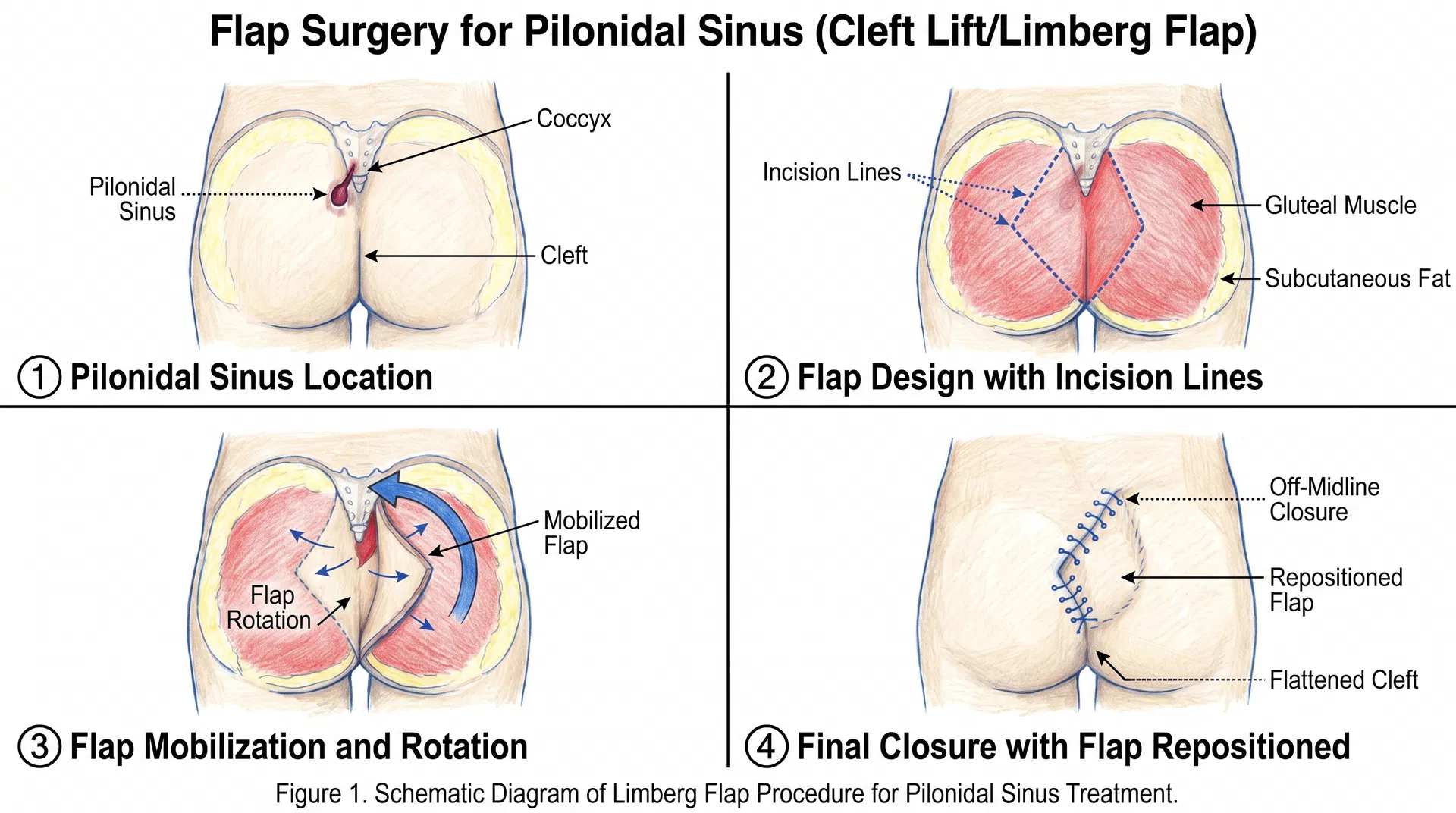
Medical illustration: Flap surgery for pilonidal sinus - showing flap design, mobilization, and off-midline closure technique
Flap surgery is the most effective treatment for recurrent pilonidal sinus disease and is increasingly preferred by surgeons worldwide due to its superior outcomes and lowest recurrence rates.
The Limberg flap is a rhomboid-shaped skin flap that is rotated to fill the excision defect. This technique effectively flattens the natal cleft and moves the scar away from the midline. It has a recurrence rate of 2-5% and is excellent for extensive or recurrent disease.
Advantages: Lowest recurrence rate, excellent cosmetic results, flattens natal cleft, reliable healing
The Karydakis procedure involves asymmetric excision of the sinus with off-midline closure. This technique flattens the natal cleft and reduces moisture accumulation. It has a recurrence rate of 3-7% and is Dr Adarsh's preferred technique for primary disease requiring definitive excision.
Advantages: Off-midline wound heals better, flattens natal cleft, excellent cosmetic result, low recurrence
Z-plasty involves making triangular flaps on either side of the midline after sinus removal. These flaps are then repositioned to fill the cavity. This technique provides better aesthetic outcomes and reduces tension on wound edges.
Advantages: Better aesthetic outcomes, reduces wound tension, faster healing, low recurrence
This advanced technique uses a larger area of skin and tissue beneath to cover the defect. It's particularly useful for larger defects and provides robust coverage with excellent blood flow.
Advantages: Excellent for large defects, robust coverage, good blood flow, reliable healing
Cases that have recurred after previous laser or open surgery treatments.
Multiple sinus tracts affecting both sides of the buttock or extensive tissue involvement.
Patients who want the most definitive treatment with the lowest recurrence rate.
Patients concerned about scarring, as flap surgery provides excellent cosmetic results.
When other treatment options have not provided adequate results.
Flap surgery for pilonidal sinus involves several key steps designed to ensure complete removal of diseased tissue while providing excellent healing and cosmetic outcomes.
General or spinal anesthesia is administered. The patient is positioned face-down. The surgical area is cleaned and sterilized.
The surgeon designs the flap (Limberg, Karydakis, or Z-plasty) based on the extent of disease and desired outcome.
The entire sinus tract and surrounding infected tissue are completely removed. All debris and hair are carefully excised.
The skin flap is carefully mobilized and prepared for repositioning. The flap is rotated or shifted to cover the excision defect.
The flap is sutured into place with off-midline closure. This flattens the natal cleft and reduces recurrence risk.
Sterile dressings are applied. Drainage tubes may be placed if needed. Post-operative care instructions are provided.
| Factor | Flap Surgery | Laser Treatment | Open Surgery |
|---|---|---|---|
| Recovery Time | 2-3 weeks | 1-2 weeks | 2-4 weeks |
| Success Rate | 99% | 99% | 90% |
| Recurrence Rate | 2-5% (Lowest) | 1-5% | 10-20% |
| Hospital Stay | 1 day | Day-care | 1-2 days |
| Pain Level | Minimal | Minimal | Moderate |
| Cosmetic Result | Excellent | Excellent | Good |
| Best For | Recurrent cases | Primary cases | Complex cases |
Minimal pain and discomfort. Dressing changes as needed. Avoid sitting for extended periods. Take prescribed antibiotics and pain relief medication. Limited mobility.
Pain significantly decreases. Dressing changes reduced. Can start light activities. Avoid strenuous exercise. Wound should show good healing.
Can return to desk jobs and light activities. Avoid heavy lifting. Continue wound care. Most dressing changes complete.
Complete healing and return to all normal activities. Can resume gym and sports. Wound fully healed. Excellent cosmetic result.
Dr Adarsh M Patil is a highly experienced general surgeon specializing in pilonidal sinus treatment with 25+ years of clinical practice. He has successfully treated patients through individualised care using all advanced surgical techniques including flap surgery, laser, and open surgery.
Qualifications: MBBS, MS (General Surgery), Fellowship in Advanced Laparoscopy & Bariatric Surgery (Belgium), FILHS (Boston University, USA)
KMC Registration: #53728 (Year: 1999)
Practice Location: Apollo Clinic, Indiranagar, Bengaluru
Specialization: Advanced Laparoscopic, Bariatric, Robotic, and GI Cancer Surgery; Pilonidal Sinus (all procedures)
Contact: +91 80889 87384
Limberg flap uses a rhomboid-shaped flap rotated to fill the defect, while Karydakis uses asymmetric excision with off-midline closure. Both have excellent results, with Limberg having slightly lower recurrence (2-5% vs 3-7%). Dr Adarsh chooses the best technique based on disease extent.
No, the procedure is performed under general or spinal anesthesia. You will be completely unconscious or numb during surgery. Post-operative pain is minimal and well-managed with prescribed medication.
The procedure typically takes 60-90 minutes depending on the complexity and extent of disease. You will spend additional time in recovery before being discharged.
Flap surgery has the lowest recurrence rate among all pilonidal sinus treatments: 2-5% for Limberg flap and 3-7% for Karydakis procedure. This is significantly lower than laser (1-5%) or open surgery (10-20%).
Most patients can return to desk jobs within 1-2 weeks. Return to strenuous activities and heavy lifting should wait 3-4 weeks. Full recovery takes 2-3 weeks.
Yes, flap surgery is a safe and proven procedure with minimal complications. It is performed under general or spinal anesthesia with proper medical supervision. Complications are rare.
The cost typically ranges from ₹80,000 to ₹1,50,000 depending on the flap type and hospital. Most insurance plans cover the procedure. EMI options are available. Contact us for exact pricing.
Flap surgery flattens the natal cleft and moves the scar away from the midline, addressing the anatomical factors that cause recurrence. This results in the lowest recurrence rates among all treatments.
2-5%
Recurrence Rate (Lowest)
2-3 Weeks
Recovery Time
99%
Success Rate
Excellent
Cosmetic Result
Before you enquire
Pilonidal sinus can be difficult to discuss. The information below makes it easier to check the clinician, clinic, reviews, and next steps before sharing your details.
Dr Adarsh M. Patil, MS, FMAS · Karnataka Medical Council registration 53728.
View doctor profile4.8/5 on Google, based on 73 public reviews on the clinic’s Google Business Profile.
View Google reviewsVisit or call the Indiranagar clinic and view additional Bengaluru consultation locations before booking.
View clinic locationsTreatment suitability, expected recovery, costs, benefits, and risks are discussed after an individual consultation.
Read our care standardspatients through individualised care who have successfully treated their pilonidal sinus with Dr Adarsh Patil using advanced flap surgery techniques
Explore All Options
Dr Adarsh Patil offers multiple evidence-based approaches. The right choice depends on your specific condition.
Minimally invasive day-care procedure. individual treatment planning, 1–2 week recovery.
Traditional surgical approach for complex cases. Proven long-term outcomes.
Endoscopic pilonidal sinus treatment — ultra-minimally invasive.

Chief Author & Medical Editor
Dr Adarsh M. Patil, MS, FMAS | Karnataka Medical Council Registration: 53728 | 25+ Years Experience
About the Medical Reviewer: Dr Adarsh M. Patil is a Bengaluru-based surgeon with a focus on pilonidal sinus care. Pages that carry this panel are reviewed for patient-facing clarity and are updated when clinical information changes. Website information supports, but never replaces, an individual consultation.
The information on this website is for patient education and does not replace an individual medical assessment, diagnosis, or treatment plan. Pages carrying a medical reviewer panel are reviewed by Dr Adarsh M. Patil for patient-facing clarity.
Important: Always consult with a qualified healthcare provider before making any medical decisions. The content on this website does not replace professional medical consultation, diagnosis, or treatment.
If you experience severe symptoms or medical emergencies, please seek immediate medical attention at the nearest hospital or emergency room.
Content disclosure: Some website drafts may be prepared with writing assistance and then edited for patient-facing clarity. Do not rely on website content alone to make medical decisions; discuss your own symptoms and treatment suitability during a consultation.
Medical reviewer: Dr Adarsh M. Patil, MS, FMAS | KMC Registration: 53728 | Last Updated: September 22, 2026
MS, FMAS — Pilonidal Sinus Specialist, Bangalore
Consult Dr. Adarsh M. Patil — Pilonidal Sinus Specialist
Discuss laser and surgical options, likely recovery, costs, and next steps after an individual assessment.