Laser Treatment vs Open Surgery: Which Is Right for You?
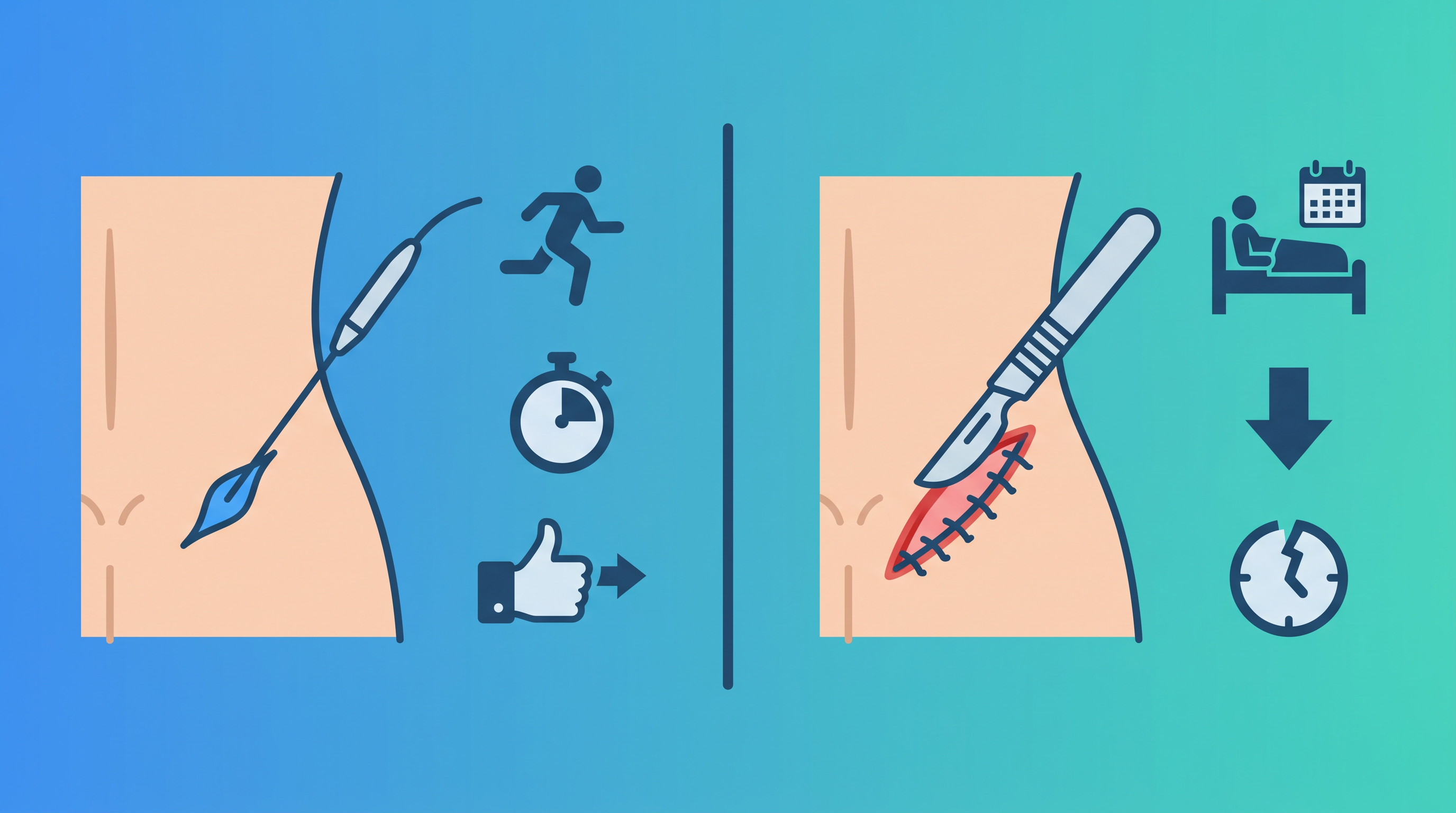
Laser treatment (FiLaC/SiLaC) offers faster recovery (1–2 weeks) and lower recurrence than open surgery (2–4 weeks). Both have 99% success rates. Your doctor will recommend the best option based on your condition severity and lifestyle.
Choosing between laser treatment and open surgery for pilonidal sinus can feel overwhelming. This guide breaks down the key differences in plain language so you can have an informed conversation with Dr. Adarsh M. Patil.
When to Seek Urgent Care
🚨 If you have a rapidly growing, extremely painful lump near your tailbone with fever, go to the emergency room immediately — this may be a large abscess requiring emergency drainage.
Seek urgent care if you have:
- •Fever above 38°C with severe tailbone pain
- •Rapidly enlarging, very tender swelling
- •Inability to sit due to pain
- •Spreading redness beyond the immediate area
In Bangalore: Call 108 for emergencies or visit your nearest hospital.
How Laser Treatment Works
Laser treatment (FiLaC — Fistula-tract Laser Closure, or SiLaC — Sinus Laser Closure) uses a thin laser fiber inserted into the sinus tract. The laser energy destroys the sinus lining from the inside, causing it to collapse and heal. The procedure is performed under local anesthesia and takes 20–40 minutes.
Advantages of laser treatment:
- Day-care procedure — go home the same day
- No large incision or open wound
- Return to work in 1–2 weeks
- 1–5% recurrence rate
- Minimal post-operative pain
How Open Surgery Works
Open surgery involves making an incision to remove the entire sinus tract and surrounding tissue. The wound may be left open to heal from the inside (open technique) or closed with stitches (closed technique). This is performed under general or spinal anesthesia.
Advantages of open surgery:
- Complete removal of the sinus tract
- Well-established, proven technique
- Suitable for complex, multi-tract disease
- Lower initial cost in some cases
Side-by-Side Comparison
Laser treatment takes 1–2 weeks recovery vs 2–4 weeks for open surgery. Both have 99% success rates. Laser has 1–5% recurrence vs 5–15% for open surgery. Laser is a day-care procedure vs 1–2 days hospital stay for open surgery.
Which Should You Choose?
Dr. Adarsh M. Patil recommends laser treatment for most first-time, uncomplicated cases because of the faster recovery and lower recurrence. Open surgery is preferred for complex cases with multiple sinus tracts, recurrent disease after previous laser treatment, or very large abscesses.
Open surgery involves making an incision to remove the entire sinus tract and surrounding tissue. The wound may be left open to heal from the inside (open technique) or closed with stitches (closed technique). This is performed under general or spinal anesthesia.
Advantages of open surgery:
- Complete removal of the sinus tract
- Well-established, proven technique
- Suitable for complex, multi-tract disease
- Lower initial cost in some cases
Side-by-Side Comparison
Laser treatment takes 1–2 weeks recovery vs 2–4 weeks for open surgery. Both have 99% success rates. Laser has 1–5% recurrence vs 5–15% for open surgery. Laser is a day-care procedure vs 1–2 days hospital stay for open surgery.
Which Should You Choose?
Dr. Adarsh M. Patil recommends laser treatment for most first-time, uncomplicated cases because of the faster recovery and lower recurrence. Open surgery is preferred for complex cases with multiple sinus tracts, recurrent disease after previous laser treatment, or very large abscesses.
Dr. Adarsh M. Patil recommends laser treatment for most first-time, uncomplicated cases because of the faster recovery and lower recurrence. Open surgery is preferred for complex cases with multiple sinus tracts, recurrent disease after previous laser treatment, or very large abscesses.
Medical References & Sources
- [1]Laser Treatment for Pilonidal Sinus. PubMed, 2024. View source ↗
- [2]Pilonidal Sinus: Surgical Options. BMJ Best Practice, 2023. View source ↗

Dr. Adarsh M. Patil
MS, FMAS — Pilonidal Sinus Specialist, Bangalore
Consult Dr. Adarsh M. Patil — Pilonidal Sinus Specialist
Discuss laser and surgical options, likely recovery, costs, and next steps after an individual assessment.