
Pilonidal Sinus vs Abscess vs Cyst: Understanding the Key Differences
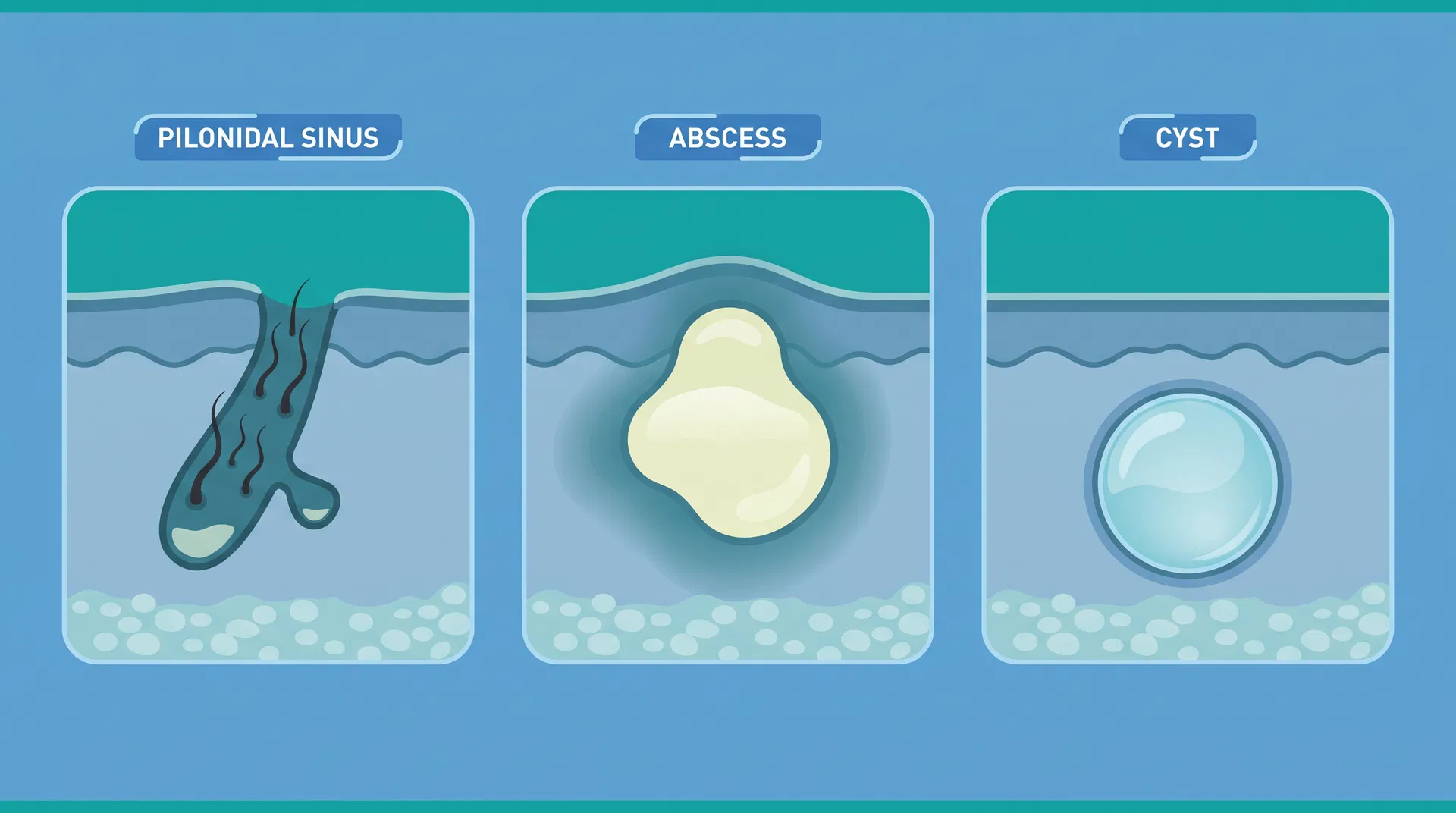
A pilonidal sinus is a tunnel in the skin near the tailbone containing hair. A pilonidal abscess is an infected, pus-filled pilonidal sinus. A pilonidal cyst is a fluid-filled sac. These terms are often used interchangeably but have important clinical differences that affect treatment. Understanding the difference helps you communicate better with your doctor.
Patients often use the terms pilonidal sinus, pilonidal abscess, and pilonidal cyst interchangeably, but they describe different stages and presentations of the same underlying condition. Understanding the distinction helps you better understand your diagnosis and the treatment your doctor recommends.
When to Seek Urgent Care
🚨 A pilonidal abscess requires urgent medical attention. If you have severe pain, fever, and a rapidly enlarging swelling near your tailbone, seek immediate care.
Seek urgent care if you have:
- •Severe sudden-onset pain
- •Fever above 38°C
- •Rapidly enlarging tender swelling
- •Inability to sit due to pain
In Bangalore: Call 108 for emergencies or visit your nearest hospital.
What Is a Pilonidal Sinus?
A pilonidal sinus is a small tunnel or tract in the skin, typically located in the natal cleft (the crease between the buttocks) near the tailbone. The word "pilonidal" comes from Latin: *pilus* (hair) + *nidus* (nest).
Key characteristics:
- A narrow tunnel or channel in the skin
- Often contains loose hair, skin debris, and bacteria
- May have one or multiple external openings (pits)
- Can be asymptomatic or cause chronic discharge
- The underlying condition that causes abscesses and cysts
What Is a Pilonidal Abscess?
A pilonidal abscess occurs when a pilonidal sinus becomes acutely infected, forming a collection of pus. This is the most painful presentation.
Key characteristics:
- Sudden onset of severe pain
- Tender, swollen, red lump near the tailbone
- May have fever and general malaise
- Requires urgent drainage
- Often the first presentation that brings patients to the doctor
What Is a Pilonidal Cyst?
A pilonidal cyst is a fluid-filled sac that forms in the same area. The term is often used loosely to describe the entire condition, but technically a cyst is a closed sac lined by epithelium.
Key characteristics:
- Fluid-filled sac (not necessarily infected)
- May be asymptomatic for long periods
- Can become a sinus or abscess if it becomes infected
- Often discovered incidentally
Comparison Table
| Feature | Pilonidal Sinus | Pilonidal Abscess | Pilonidal Cyst |
|---------|----------------|-------------------|----------------|
| Definition | Skin tunnel with hair | Infected pus collection | Fluid-filled sac |
| Pain level | Mild to moderate | Severe | Mild to none |
| Onset | Gradual | Sudden | Gradual |
| Urgency | Elective treatment | Urgent drainage | Elective treatment |
| Treatment | Surgery/laser | Drainage + surgery | Surgery |
How Dr. Adarsh M. Patil Diagnoses Your Condition
Dr. Adarsh M. Patil at Apollo Clinic Indiranagar, Bangalore (KMC Reg: 53728, +91 9972446882) uses a combination of:
- Clinical examination: Inspection and palpation of the natal cleft
- Probing: Gentle probing to assess the extent of the sinus tract
- Ultrasound: To assess depth and complexity of the sinus
- MRI: For complex or recurrent cases to map all tracts
Treatment Based on Presentation
#Pilonidal Abscess (Urgent)
- Incision and drainage under local anesthesia
- Antibiotics if cellulitis is present
- Definitive surgery planned 6-8 weeks later
#Pilonidal Sinus (Elective)
- Laser treatment (FiLaC) for simple cases
- Open excision for complex cases
- Flap surgery for recurrent cases
#Pilonidal Cyst (Elective)
- Excision of the cyst with or without primary closure
- Laser ablation if there is a sinus component
Understanding your specific diagnosis helps you have a more informed conversation with Dr. Adarsh M. Patil about the best treatment approach for your case.
A pilonidal abscess occurs when a pilonidal sinus becomes acutely infected, forming a collection of pus. This is the most painful presentation.
Key characteristics:
- Sudden onset of severe pain
- Tender, swollen, red lump near the tailbone
- May have fever and general malaise
- Requires urgent drainage
- Often the first presentation that brings patients to the doctor
What Is a Pilonidal Cyst?
A pilonidal cyst is a fluid-filled sac that forms in the same area. The term is often used loosely to describe the entire condition, but technically a cyst is a closed sac lined by epithelium.
Key characteristics:
- Fluid-filled sac (not necessarily infected)
- May be asymptomatic for long periods
- Can become a sinus or abscess if it becomes infected
- Often discovered incidentally
Comparison Table
| Feature | Pilonidal Sinus | Pilonidal Abscess | Pilonidal Cyst |
|---------|----------------|-------------------|----------------|
| Definition | Skin tunnel with hair | Infected pus collection | Fluid-filled sac |
| Pain level | Mild to moderate | Severe | Mild to none |
| Onset | Gradual | Sudden | Gradual |
| Urgency | Elective treatment | Urgent drainage | Elective treatment |
| Treatment | Surgery/laser | Drainage + surgery | Surgery |
How Dr. Adarsh M. Patil Diagnoses Your Condition
Dr. Adarsh M. Patil at Apollo Clinic Indiranagar, Bangalore (KMC Reg: 53728, +91 9972446882) uses a combination of:
- Clinical examination: Inspection and palpation of the natal cleft
- Probing: Gentle probing to assess the extent of the sinus tract
- Ultrasound: To assess depth and complexity of the sinus
- MRI: For complex or recurrent cases to map all tracts
Treatment Based on Presentation
#Pilonidal Abscess (Urgent)
- Incision and drainage under local anesthesia
- Antibiotics if cellulitis is present
- Definitive surgery planned 6-8 weeks later
#Pilonidal Sinus (Elective)
- Laser treatment (FiLaC) for simple cases
- Open excision for complex cases
- Flap surgery for recurrent cases
#Pilonidal Cyst (Elective)
- Excision of the cyst with or without primary closure
- Laser ablation if there is a sinus component
Understanding your specific diagnosis helps you have a more informed conversation with Dr. Adarsh M. Patil about the best treatment approach for your case.
| Feature | Pilonidal Sinus | Pilonidal Abscess | Pilonidal Cyst |
|---------|----------------|-------------------|----------------|
| Definition | Skin tunnel with hair | Infected pus collection | Fluid-filled sac |
| Pain level | Mild to moderate | Severe | Mild to none |
| Onset | Gradual | Sudden | Gradual |
| Urgency | Elective treatment | Urgent drainage | Elective treatment |
| Treatment | Surgery/laser | Drainage + surgery | Surgery |
How Dr. Adarsh M. Patil Diagnoses Your Condition
Dr. Adarsh M. Patil at Apollo Clinic Indiranagar, Bangalore (KMC Reg: 53728, +91 9972446882) uses a combination of:
- Clinical examination: Inspection and palpation of the natal cleft
- Probing: Gentle probing to assess the extent of the sinus tract
- Ultrasound: To assess depth and complexity of the sinus
- MRI: For complex or recurrent cases to map all tracts
Treatment Based on Presentation
#Pilonidal Abscess (Urgent)
- Incision and drainage under local anesthesia
- Antibiotics if cellulitis is present
- Definitive surgery planned 6-8 weeks later
#Pilonidal Sinus (Elective)
- Laser treatment (FiLaC) for simple cases
- Open excision for complex cases
- Flap surgery for recurrent cases
#Pilonidal Cyst (Elective)
- Excision of the cyst with or without primary closure
- Laser ablation if there is a sinus component
Understanding your specific diagnosis helps you have a more informed conversation with Dr. Adarsh M. Patil about the best treatment approach for your case.
#
Pilonidal Abscess (Urgent)
- Incision and drainage under local anesthesia
- Antibiotics if cellulitis is present
- Definitive surgery planned 6-8 weeks later
#Pilonidal Sinus (Elective)
- Laser treatment (FiLaC) for simple cases
- Open excision for complex cases
- Flap surgery for recurrent cases
#Pilonidal Cyst (Elective)
- Excision of the cyst with or without primary closure
- Laser ablation if there is a sinus component
Understanding your specific diagnosis helps you have a more informed conversation with Dr. Adarsh M. Patil about the best treatment approach for your case.
- Laser treatment (FiLaC) for simple cases
- Open excision for complex cases
- Flap surgery for recurrent cases
#
Pilonidal Cyst (Elective)
- Excision of the cyst with or without primary closure
- Laser ablation if there is a sinus component
Understanding your specific diagnosis helps you have a more informed conversation with Dr. Adarsh M. Patil about the best treatment approach for your case.
Medical References & Sources
- [1]Pilonidal Sinus Disease. Mayo Clinic, 2023. View source ↗
- [2]Pilonidal disease overview. NHS, 2023. View source ↗

Dr. Adarsh M. Patil
MS, FMAS — Pilonidal Sinus Specialist, Bangalore
Consult Dr. Adarsh M. Patil — Pilonidal Sinus Specialist
Discuss laser and surgical options, likely recovery, costs, and next steps after an individual assessment.